Holiday
Composition
Occasion
If you've ever noticed a cloud of tiny white flowers in a bouquet, so delicate they seem almost weightless, you've probably seen baby's breath, or gypsophila. Most people recognize it instantly even if they don't know its name. It's also one of the most useful flowers in floristry: it rarely needs to be the star of an arrangement, yet it can make an entire bouquet look lighter, fuller, and more refined. You can browse bouquets and arrangements featuring gypsophila at Pion.kz. Below, we'll explain why florists use it and when baby's breath works beautifully on its own.

Gypsophila is a flowering plant with masses of tiny white or pale pink blooms growing on thin, branching stems. Its botanical name is Gypsophila, while in English it is much better known as baby's breath.
In floristry, baby's breath can serve several purposes at once:
That's why baby's breath is more than simply a “filler flower.” Used well, it is a genuine design element that can change the overall character of a bouquet.
Gypsophila can be paired with many different flowers, but some combinations work particularly well.
This is perhaps the most classic combination. White baby's breath softens the strong shape of red or pink roses and gives the bouquet a more romantic, delicate appearance. It works with both long-stemmed Dutch roses and spray roses. With spray roses, the result can have an especially soft, garden-inspired look.

With sunflowers
An unexpected but striking combination. Large yellow sunflower heads surrounded by a cloud of white baby's breath create a bright, summery bouquet that still feels light and balanced. The tiny white flowers soften the strong contrast between yellow petals and green foliage.
With eustoma and peony-style roses
In pastel arrangements, baby's breath adds volume and airiness without disrupting the soft color palette. White or very pale pink gypsophila pairs especially well with the cream, blush, and powdery tones of eustoma and peony-style roses.
With chrysanthemums and alstroemerias
In everyday or more affordable bouquets, gypsophila adds texture, volume, and a more finished appearance. Even a small amount can make a simple chrysanthemum or alstroemeria bouquet feel more detailed and thoughtfully arranged.

When to use it more carefully:
Gypsophila provides less visual contrast when it is combined with other very small, delicate flowers such as ammi or astrantia. These combinations can still work beautifully, particularly in natural or meadow-style arrangements, but they require more careful composition to keep the different textures from blending together.
A mono-bouquet of baby's breath isn't simply a substitute for more expensive flowers — it can be a deliberate style choice. It looks unusual, airy, and delicate, while its cloud-like shape photographs beautifully.
A baby's breath bouquet works particularly well for:
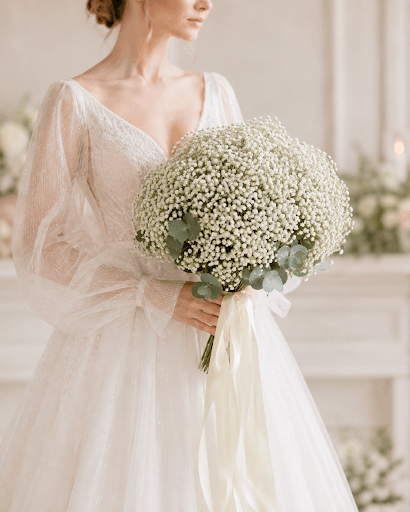
Fresh baby's breath can remain attractive for around a week or longer depending on its freshness, the variety, and the conditions in which it is kept. One of its advantages is that even as it dries, it can retain much of its characteristic airy shape.
How to dry baby's breath:
Gypsophila is one of the best flowers for dried arrangements because it retains its delicate, cloud-like structure remarkably well. To dry it, gather a few stems into small bunches and hang them upside down in a dry, dark, well-ventilated place for about 2–3 weeks. Once completely dry, baby's breath can remain an attractive decorative element for many months.
You can browse available arrangements and order delivery across Almaty in the Pion.kz gypsophila collection. For the full selection of flowers, visit Pion.kz. Orders are accepted 24/7 through our website or via WhatsApp: +7 707 365 05 05.
Baby's breath rarely demands all the attention in a mixed bouquet, but it is often the detail that makes the arrangement feel complete. If you want to add softness, volume, and an airy quality to a bouquet, gypsophila is one of the most versatile flowers a florist can use.